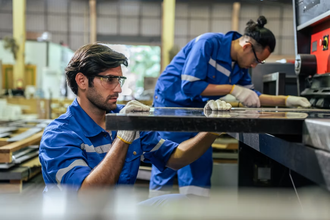

Get up and look around the room you happen to be sitting in. Someone connected the electric wires for the lights you see. A person installed the pipes for the sink that brings you water. Someone made the ground sturdy for your building, as well as constructed your walls. No one of these works happened by sheer chance. Every one of them needed a tradesperson to do the actual hand work involved.
People often don’t realize what these conveniences entail. They simply flick a switch or open a faucet, never thinking about the rest. And yet, for every tiny moment like that a huge network of skilled workers is behind it, they are the ones who have built, installed, and kept running our daily systems. Electricians, plumbers, welders, carpenters, HVAC technicians, and mechanics, these are the people keeping things running on a daily basis, often without getting much praise for it.
The Work Nobody Notices Until It Breaks
There is always an unusual link between trade work and attention. It is only when there are no problems that people completely forget about these essential services. The lights go on, the heating is provided, the car starts, and the sink doesn’t overflow. We are reminded of how much the tradesmen are needed to solve such problems only when we have to call them.
Frankly, it’s tough to take. Someone may devote decades to developing a specific ability and be noticed only once in a crisis. However, that very situation points to a bigger truth. The labor itself isn’t a choice. The ability isn’t a nice-to-have extra or a fun activity that you can switch off at will. The work underpins everything else, the way infrastructure supports a building, both literally and metaphorically.
Think about the effects on a city if the electricians and plumbers just stopped coming for a month. Cracks in the pavement and nobody would be there to do anything about it. The pipes, like veins of the city, will be leaking and yet, no one to come and fix it. Soon, the problems that have been going on for years would be glaringly obvious at every corner of the city. So it is, in fact, a vital work that these people are doing, even though it is often so quiet that they become practically invisible while doing it.
Skill That Takes Years to Build
There’s a tired idea floating around that trade work is simple or low-skill compared to office jobs. Anyone who has actually stood in a crawl space trying to figure out why a furnace won’t fire, or tried to read a blueprint and translate it into a finished wall, knows how false that idea is.
Learning a trade takes years. Apprenticeships often run three to five years, combining classroom time with thousands of hours on the job. A first-year apprentice and a twenty-year journeyman are not doing the same work, even if the tools look similar. Reading a situation correctly, working around unexpected problems, and getting the details right the first time takes real experience. Mistakes in this line of work aren’t just inconvenient. A wiring error can start a fire. A gas line mistake can be deadly. The margin for error is thin, and the training reflects that.
In addition to the technical skill this is a physically demanding job which also requires solving problems under pressure and communicating to a customer in laymen terms the nature of the repair. The blend of the ability of the hands on work and interpersonal skills is hard to acquire and deserves more respect than it is usually granted.
The numbers back this up. Most electricians spend four to five years in a paid apprenticeship, logging around 2,000 hours of hands-on training every single year on top of classroom instruction, according to the U.S. Bureau of Labor Statistics. That’s not a weekend certification. That’s roughly the same time commitment as a bachelor’s degree, minus the tuition bill, spent learning something you can’t fake your way through.
There’s also the licensing issues, which most people don’t even think about. Electro installation experts and gas fitters, as typical examples, generally need to pass the state test before they can qualify for work without a direct supervisor. These examinations are related to safety standards, local laws and technical aspects requiring serious study to understand. It’s quite the contrast from the licensing procedures in other skilled professions. However, trade licenses seldom receive the same recognition.
The Country Runs on This Work
Zoom out far enough, and you start to see how much of the economy actually depends on trade work. New housing can’t get built without framers, electricians, and plumbers. Factories can’t run without maintenance techs keeping the machines going. Hospitals need HVAC systems that work every single day, no exceptions. Even the trucks that deliver groceries to your store need mechanics to keep them on the road.
It’s not an exaggeration to say the trades are the foundation the rest of the economy is built on. Office jobs, retail, healthcare, education — all of it depends on buildings that stay standing, power that stays on, and systems that keep working. Take the trades away, and the whole structure starts to wobble.
Yet for years, trade careers got pushed to the side in favor of a one-size-fits-all push toward four-year degrees. A lot of young people were told that hands-on work was a fallback option instead of a real career path. That message did real damage, both to the workforce and to the way people think about this kind of labor. The truth is that a skilled tradesperson can build a stable, well-paying career, often without the debt that comes with a traditional degree.
That damage shows up now as a shortage. Plenty of contractors will tell you they have more work than people to do it. Experienced techs are retiring faster than new workers are entering the field, and that gap is starting to show in longer wait times for repairs and higher prices for basic services. The BLS projects about 81,000 electrician job openings every year through the next decade, with employment growth in the field running well above the average for all occupations. The demand for skilled trade work isn’t shrinking. If anything, it’s becoming harder to meet.
Respect Where It’s Due
This is not to imply that being a tradesperson is simple or even at all glamorous. It’s hard work, often involves getting quite dirty, occasionally the work is dangerous, and the working hours can be very tough, particularly when it is an emergency or it is the busy season. But that’s exactly why it deserves recognition instead of being overlooked.
The next time your heating system is switched on automatically during a frosty morning, your car starts with ease, or your lights come on without a problem, please remember that there is someone who has spent many years preparing for that moment. That person studied the codes, worked hard during the apprenticeship, comes to work well ahead of time to make sure that all the systems remain functional.
Tradespeople aren’t simply workers stepping in to fill an employment gap. They are the supporting foundation of regular life, doing one repair after another, one build at a time, one job after the next. It is something we should publicly say and not just keep in mind when something is broken.