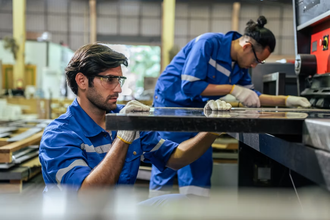

Somewhere along the way, a bad idea became common wisdom. The idea that going to college was the only real path to a good life. That working with your hands was something you settled for, not something you chose.That a blue collar career was a backup plan for people who did not have better options.
That idea was always wrong. In 2026, it is getting harder to ignore just how wrong it was.
Blue collar work is getting the recognition it deserves. More people now understand how important skilled trades are. Tradespeople have known this for years.
The Economy Runs on People Who Show Up and Do the Work
Every day, the country relies upon skilled trades workers to run our economy. Electricians ensure that both hospitals and homes have power. Plumbers supply us with clean water. HVAC workers make sure that buildings are comfortable even under the most extreme weather conditions. Welders make the infrastructure that everything else depends upon.
Around 12 million skilled trades workers help keep the country running. They build homes, repair power systems, maintain important infrastructure, and work in manufacturing. Their work is essential and affects everyone’s daily life.
Yet, for many years, trades were considered a less desirable option. Schools emphasized four-year degree programs. Parents discouraged vocational education. Success was equated with office jobs, and all else was considered inferior.
This story is coming to an end. As office jobs are disappearing through automation, the importance of manual labor is increasing. A plumber can’t be offshored. An electrician can’t be replaced by software.
An HVAC technician will not lose his job due to a new app. The work that keeps this country together is work that must be done on-site, by a person with genuine skills and proper training.
The Numbers Tell the Story
The numbers show just how much skilled trades workers are needed in the U.S. Right now, there are about 400,000 open trade jobs. Many companies are also offering signing bonuses to attract skilled workers.
More people are needed to work on wind turbines. These jobs could grow by about 50% over the next 10 years. HVAC technicians are also busy fixing old buildings and installing new energy-saving systems.
Electricians and plumbers are needed now more than ever. The demand is growing because of power grid upgrades, new EV charging stations, and solar energy projects. On top of that, older systems still need regular repairs and replacements.
Nearly 47% of the trades workers earn a six-figure salary, a figure higher than the median earnings of new college graduates. Plus, they have managed to achieve this without accumulating student debts amounting to six figures.
Pay for construction and mechanical jobs has gone up by 30% to 40% since 2020. That’s more than many office jobs. This isn’t just a short-term change. It shows that skilled trades workers are finally getting the pay they deserve.
What the Trades Offer That Most Careers Cannot
Blue-collar culture and pride go beyond just giving you a great feeling about your work (though there are many reasons to). They are also about what a trades career can provide you with that most other career paths cannot.
Below are some things that skilled tradespeople have and what office workers are increasingly looking for:
- Job security that is not dependent on market trends. Even when the economy slows down, people still need electricity, plumbing, and heating. That’s why skilled trades jobs are often more stable than many office jobs.
- A career path that is clearly defined. Trade careers have a clear path for growth. You can move from apprentice to journeyman and then to master tradesperson. Each step brings more skills, more responsibility, and higher pay.
- Being able to take full responsibility for the work you do. It is estimated that about 22 percent of tradespeople go on to start their own businesses. The trades are actually one of the most feasible options available for people who are working and wish to become business owners.
- There is no student loan debt looming over you. Trade courses are short-term, not years-long. Furthermore, you get paid while you learn.
- Real promotion based on ability rather than office politics. In the trades, it is your knowledge and skill that dictate your advancement opportunities.
The Perception Is Finally Changing
For many years, people looked down on blue-collar jobs. That belief was unfair. Today, more people are starting to see their true value.
For the first time in many years, skilled trades are getting the respect they deserve. Many trades workers run their own businesses, earn good money, and enjoy the freedom of being their own boss. More people now see trade careers as a smart choice, not a backup plan.
Companies like Ford, Nvidia, and AT&T say they need more skilled trades workers. These workers will help build the infrastructure needed for AI and new technology. For example, AT&T plans to spend about $38 billion over the next five years to hire and train skilled technicians to expand its fiber network.
Trade school graduates are finding jobs at a higher rate than many college graduates. Their employment rate is 75%, while college graduates have a 70% rate. This shows that skilled trades are becoming a popular career choice.
Pride in the Work Is Not Optional
The role of skilled trades in America is more than just an economic point. It is also a cultural one. We need to recognize the people who are actually doing this work for who they truly are.
Blue collar workers are known for showing up, working hard, and doing the job right. These values never go out of style. In today’s changing world, having a career built on real skills and honest work is something to be proud of.
You constructed this. You repaired that. You made that function.
That is not a consolation prize. Rather, it is something to be of great pride.