You’re standing in the tool aisle at Home Depot with $300 in your pocket and a head full of dreams. Maybe you just finished your first week of trade school. Maybe you landed an apprenticeship that starts Monday. Or maybe you’re finally making the jump from retail into a real career with your hands.
Either way, you’re staring at walls of chrome and cordless batteries, and you’ve got one burning question: What do I actually need?
Let’s cut through the noise. Because how you spend your first tool dollars matters more than you think.
The Truth Nobody Tells You About Your First Tool Purchase
Here’s what your uncle, your foreman, and that guy on YouTube all got wrong: there’s no universal “starter kit” that works for everyone.
A first-year electrician needs different tools than a framing carpenter. A plumber’s essentials look nothing like an HVAC tech’s. And what you need on day one of your apprenticeship is completely different from what a veteran tradesperson carries in their van.
But here’s what is universal: you need to build a foundation before you buy the fancy stuff.
The biggest mistake new tradespeople make? Dropping their entire paycheck on a top-tier cordless drill system because it looks professional. Then they show up on site and realize they can’t mark a straight line or drive a screw without stripping the head.
Your tools should match your skill level and your actual job requirements. Not your ambitions. Not what looks cool on Instagram.
Why Hand Tools Deserve Your Respect (And Your Money First)
Let’s get one thing straight—hand tools aren’t the “cheap option” or the “starter pack” you tolerate until you can afford the real equipment. They’re fundamental to every single trade, period.
Here’s why every serious tradesperson loads up on hand tools first:
They teach you the craft. When you cut with a handsaw or chisel by hand, you learn how wood behaves. You develop feel. You understand grain direction, material resistance, and proper body mechanics. Power tools are force multipliers, but they can’t teach you fundamentals.
They never run out of batteries. Job sites lose power. Batteries die. Extension cords get buried under materials. The benefit of your 25-foot tape measure and torpedo level? They work every single time, in every condition, without fail.
They last forever. A quality hand tool—properly maintained—will outlive your truck. That $40 speed square you buy today could still be dead-accurate when you’re training your own apprentice twenty years from now.
They’re job-site proof. Hand tools get dropped, rained on, covered in mud, and tossed in the back of trucks. Most of them just keep working. Try that with a $400 cordless tool.
They build reputation. Show up knowing how to use a chalk line, a framing square, and a sharp chisel? Veterans notice. They respect craft over gear.
The Essential Hand Tool Foundation
Before you buy a single power tool, make sure you’ve got these basics locked down:
Measuring and Marking Tools
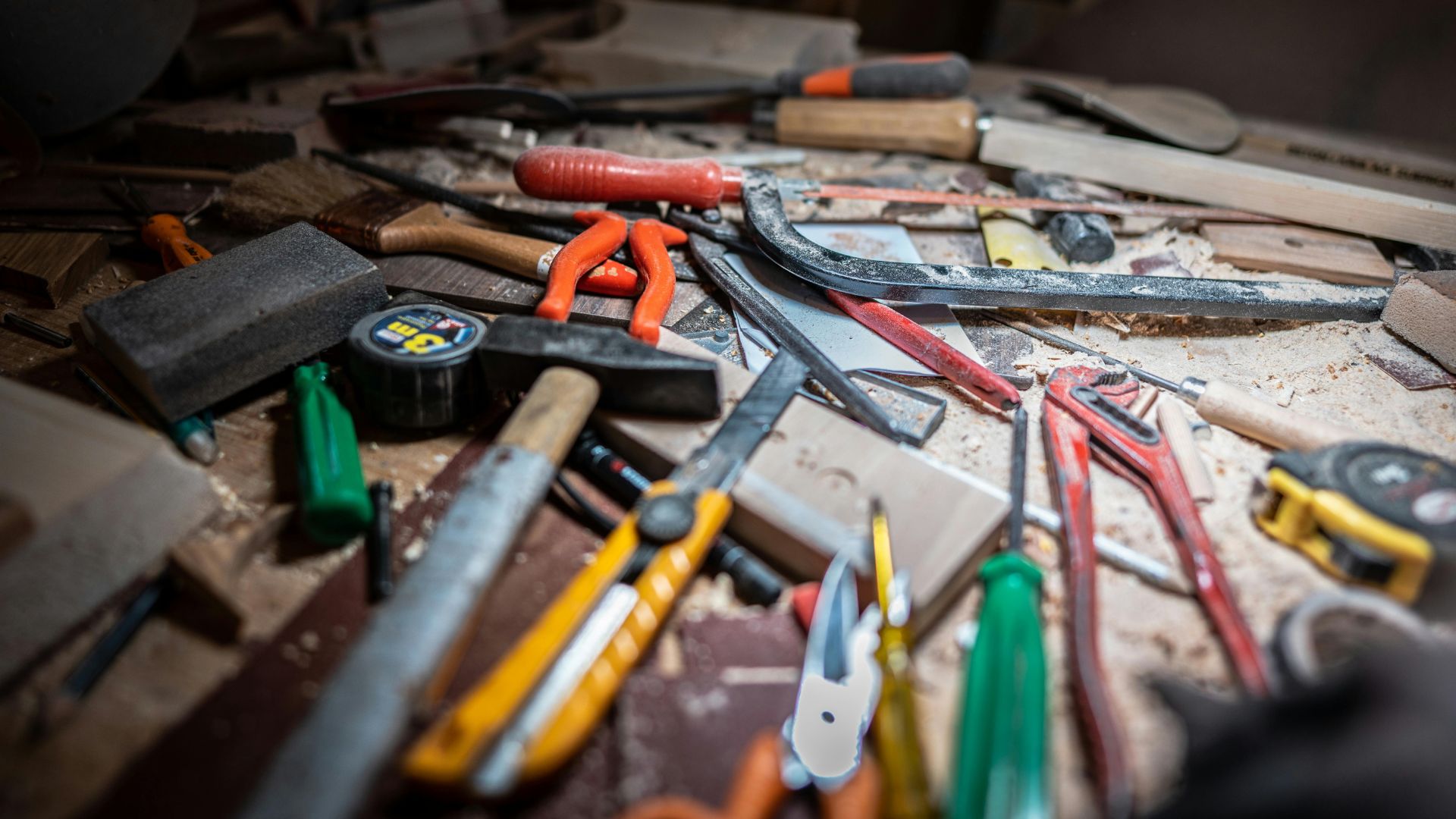
- 25-foot tape measure (buy two—you’ll probably lose one)
- Speed square
- Torpedo level and 4-foot level
- Chalk line
- Pencils and carpenter’s pencils
- Combination square
Cutting and Shaping
- Utility knife with extra blades
- Hacksaw with extra blades
- Wood chisel set (even if you’re not a carpenter)
- Tin snips (if you’re in HVAC, electrical, or metal work)
Fastening and Finishing
- Hammer
- Screwdriver set (flathead and Phillips, multiple sizes)
- Adjustable wrench
- Pliers set (needle nose, slip joint, channel locks)
You can get all of this for a few hundred dollars if you’re smart about it. And yes, you’ll use every single piece.
When Power Tools Make Sense
Here’s the thing—power tools aren’t a luxury. In modern construction, they’re absolutely necessary. But timing matters.
Buy power tools when:
You’ve got the fundamentals down. You know what you’re doing with the hand-powered version first.
Your job demands production speed. If you’re on a framing crew setting hundreds of studs a day, yes, you need a nail gun. But learn to swing a hammer first.
You’ve identified your actual needs. After a few weeks on the job, you’ll know exactly which tasks eat up your time and which tools would make the biggest impact.
You can afford quality. A $50 no-name drill will fail you at the worst possible time. Better to wait and save for something that won’t quit mid-job.
The Smart Power Tool Progression
When you’re ready to go cordless, here’s the order that makes sense for most trades:
First Purchase: Drill/Driver Combo Kit
This is your workhorse. Get an 18V or 20V system from a major brand. You’ll use it every single day. The combo kit usually includes a drill, impact driver, two batteries, and a charger—everything you need to start.
One critical note: pick a battery platform and stick with it. Your first cordless purchase locks you into an ecosystem. Choose wisely, because five years from now, you’ll have ten tools on that same battery system.
Second Purchase: Circular Saw, Reciprocating Saw or other means of cutting
Depends on your trade. Carpenters and framers need the circular saw. Plumbers, electricians, and demo guys lean toward the reciprocating saw first.
Third Purchase: Trade-Specific Tools
Now you start specializing. Impact wrench for mechanical work. Oscillating multi-tool for precision cutting. SDS rotary hammer for concrete. Whatever your specific trade demands most often.
The Misconceptions That Cost You Money
“I need pro-grade everything from day one.”
No, you don’t. You need reliable tools that match your current skill level. As you improve, upgrade strategically. A veteran carpenter can do more with basic tools than a beginner can do with a $5,000 setup.
“Hand tools are old school and outdated.”
Tell that to the finish carpenter using a hand plane or the electrician pulling wire with Klein pliers. The best tradespeople use both. Power tools for production, hand tools for precision and problem-solving.
“I should buy what everyone else on the crew has.”
Maybe. Or maybe they bought into marketing hype, or they got hooked on a battery platform ten years ago. Do your research. Ask why they chose what they chose.
“Cheap tools are fine while I’m learning.”
Some cheap tools are okay for learning. But a tape measure that won’t stay locked or a square that’s not actually square? Those teach you bad habits and slow you down. Buy smart, not cheap.
Building Your Tool Collection the Right Way
Here’s the strategy that actually works:
Start with hand tools that cover your trade’s fundamentals. Spend 60-70% of your initial tool budget here. Build a foundation that makes you competent and hireable.
Add your first cordless combo kit. Research battery platforms. Read reviews from actual tradespeople. Choose quality over price, but don’t break the bank.
Grow strategically based on actual job site experience. After three months, you’ll know exactly what you reach for most often and where you’re losing time. That’s what you buy next.
Maintain everything religiously. Clean tools after every job. Sharpen blades. Replace worn parts. A well-maintained $50 tool outperforms a neglected $200 tool every time.
Buy quality where it matters most. For tools you use daily, buy the best you can afford. For specialty tools you’ll use twice a year, mid-grade is fine or even renting.
The Real Investment Is You
Here’s what matters more than any tool purchase: your willingness to learn how to use them properly.
The best drill in the world won’t help if you don’t understand feed pressure, speed settings, and bit selection. The fanciest saw is worthless if you can’t read a cut line or set up safe support.
Invest in your skills as aggressively as you invest in your tool collection. Watch experienced tradespeople work. Ask questions. Practice on scrap materials. Read the manuals. Watch technique videos from actual professionals, not just tool reviewers.
The trades reward competence, not gear. Show up with basic tools and solid skills, and you’ll get more respect—and more work—than someone with a $10,000 tool collection and no idea how to use it.
Your Path Forward
You don’t need permission to start building your tool collection. You don’t need to wait for the “perfect” setup or the “right” time to invest in your future.
Start where you are. Buy what you need for the work you’re actually doing. Learn to use everything properly. Build your reputation on skill and reliability, not on brand names and battery voltage.
Whether you’re fresh out of high school, making a career switch, or three months into your apprenticeship, remember this: every master tradesperson started exactly where you are right now. With questions, limited funds, and the same decision about what to buy first.
They figured it out. You will too.
The blue collar future you’re building starts with the tools in your hands—but it’s powered by the knowledge in your head and the work ethic in your heart.
Now get out there and build something.
Want more straight-talk advice for building your trade career? Explore the rest of CREW Magazine’s content for real-world guidance from people who’ve walked the path you’re on.